


Identifying River Tyne Birds: A Beginner's Guide to Kingfishers, Dippers and Herons
Three birds do most of the work of turning a walk along the Tyne into a wildlife walk. A kingfisher announces itself as a streak of electric blue travelling low over the water. A dipper stands on a midstream boulder, bobs a few times, then walks straight into the current and disappears. A grey heron simply stands there, statue-still, and lets you get closer than you think you should. Learn these three and the rest of the river starts to open up: goosanders, cormorants, wagtails on the shingle, oystercatchers down on the tidal reach.
There is a reason these three are the place to start. Each one belongs to a different piece of the river — the heron to the slow margins and muddy shallows, the dipper to fast stony water, the kingfisher to quiet pools and easy perches above small fish. Once you can read which bird belongs where, you stop hoping and start predicting. That is the difference between a lucky walk and a good one.
Kingfisher: the flash of electric blue
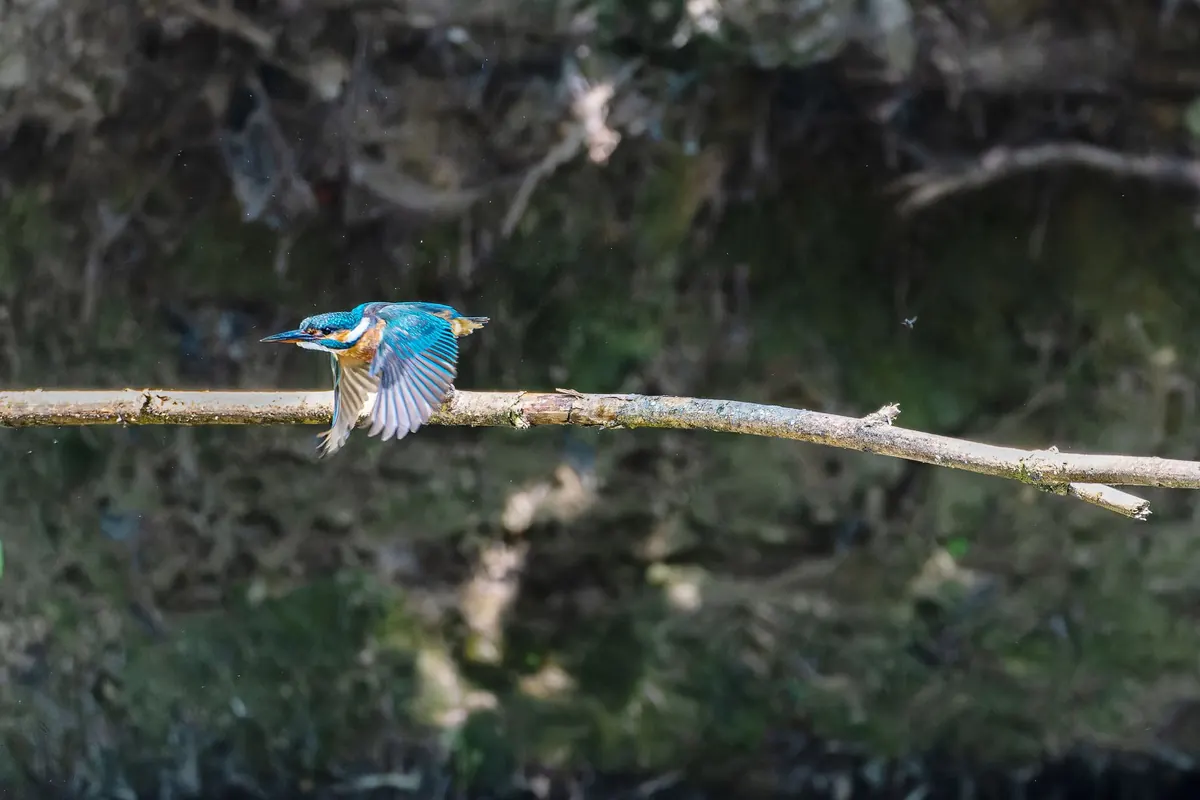
A kingfisher is about the size of a sparrow and shaped like a dart: big head, stubby tail, long black dagger of a bill. The colour is what stops people mid-sentence. The back and wings are a shifting blue-green that looks dull until sunlight catches it, and then looks like a light being switched on. Beneath, it is a rich rust-orange. Adults have bright orange-red feet, and the female's lower bill is orange-red too — one of the few straightforward ways to sex a British bird.
That blue is worth a second's thought, because it is not really there. Kingfisher feathers contain no blue pigment at all; the colour comes from the way microscopic structures inside the feather scatter light. It is the same trick that gives a peacock's neck and a morpho butterfly's wing their shimmer, and it is why a kingfisher in shade can look almost uniformly dark, while one in low winter sun looks as though it has been plugged in.
You will often hear one before you see it: a thin, sharp, high-pitched whistle, usually given twice in quick succession as the bird flies. The flight is the giveaway. It goes low, straight and fast, a foot or so above the surface, wings whirring, following the line of the river rather than crossing it.
Kingfishers need shallow water with plenty of small fish, and a vertical bank of soft earth to tunnel a nest into — a dark burrow up to a metre long, which smells strongly of fish by the time the chicks are grown. On the Tyne that means quiet stretches, eddies below weirs, backwaters and the lower reaches of tributaries. Winter is the easiest season. Once the leaves are off there are fewer places to hide, and a cold snap pushes birds onto whatever water stays open — often the tidal stretch.
Dipper: the bird that walks underwater
Dippers are the opposite of showy. A dipper is plump, short-tailed and chocolate-brown, with a bright white throat and upper chest and a chestnut band below it. It perches on wet stones in the middle of fast water and bobs — a quick, constant dipping of the whole body, as if doing knee bends. The bobbing is not nerves. It is part of how the bird steadies itself and judges the water in front of it.
Then it does the thing that makes it unforgettable. It walks off the stone into the current, holds on with its feet, and uses its wings to swim down through the water, turning over gravel for insect larvae. Watch for the flash of white eyelids when it blinks — a tiny signal in a great deal of moving water.
Everything about a dipper is built for that life: dense waterproof plumage, a low centre of gravity, and an unusually thick layer of down. It is the only British songbird that feeds underwater, and it holds the same stretch of river all year instead of moving on.
The call is a hard, sharp note, often lost in the noise of the water, but the song — a loud, rippling, hurrying series of notes — carries over a riffle from around January onwards, when pairs re-form and territories are defended. Dippers nest early, in a mossy dome tucked under bridges, in culverts, behind waterfalls and among the roots of banks, sometimes with eggs in the nest before the year's hardest weather has passed. Because they stay put, walking the same place again and again keeps paying off. Look for them where the water is fast, shallow and stony.
Grey heron: the statue that moves
A grey heron stands close to a metre tall and is unmistakable on land: long pale legs, long yellow dagger of a bill, white head and neck, and a black stripe running back from the eye into a thin trailing plume. The body is soft grey with darker flight feathers, and the shoulder plumes hang loose and ragged. Standing hunched with its neck drawn down into its shoulders, it can look like a garden ornament — until it moves.
Then you see the other bird. A hunting heron does not rush. It lifts one foot, holds it, puts it down, and repeats, for minutes at a time. The neck uncoils, the head tilts, and the strike is over before you have finished registering it: a straight, fast jab into the water, and a fish, an eel, a frog or a small mammal held crosswise and worked down whole. Herons take whatever is catchable and the right size, which is why they repay close watching on a river. Ducklings, water voles and young rats are all on the menu.
In flight a heron is just as distinctive. Unlike a cormorant, which stretches its neck out ahead of the body, a heron pulls its head back into its shoulders and flies with a long, shallow, unhurried wingbeat, legs trailing behind like a pair of thin sticks. The harsh, creaky fraaank it gives when disturbed is one of the most recognisable river sounds there is.
Herons nest colonially, sometimes dozens of pairs together in a heronry high in the crowns of tall trees, often near water but occasionally surprisingly far from it. Away from the nest they are usually solitary, and a single bird working the same stretch of bank becomes a familiar sight within a few weeks.
Knowing the supporting cast
The three above are the ones that make people stop. But the Tyne holds a good deal more, and if you can name four or five of these you will spend far less of a walk wondering what you have just seen.
- Goosander: a large, low-sitting sawbill duck. The male is creamy white with a dark bottle-green head; the female is grey with a rich reddish-brown head and a shaggy crest. They dive for fish in the deeper, slower stretches, and are commonest here in winter.
- Cormorant: big, black and snaky, often seen standing on a post or a weir with its wings held out to dry. In flight, look for the long neck stretched forward and the rapid wingbeats.
- Grey wagtail: slim, with a slate-grey back, lemon underparts and an absurdly long tail that it bobs constantly. Despite the name it is most at home beside running water, and it is the wagtail worth checking on the river.
- Pied wagtail: black and white, bolder in pattern, more often on gravel, concrete and car parks than in the water itself.
- Oystercatcher: black and white with a bright orange-red bill, pink legs and a loud piping call that carries across the whole estuary. On the lower tidal stretch you will hear it long before you see it.
Where to look along the Tyne
It helps to think of the river as three pieces rather than one.
The tidal reach
From Newcastle Quayside down through Wallsend and Jarrow to the estuary, the water is slow, deep and muddy, and it rises and falls twice a
Photo: Siegfried Poepperl / Pexels